Running pace calculator
Work out your pace, finish time or distance: enter two and see the third. With your pace per kilometer or per mile, your speed and what your form predicts for 5K, 10K, the half and the full marathon.
For example 25:30 or 1:52:00.
Your pace
5:30min/km
- Speed
- 10.9 km/h
- Pace per mile
- 8:51 min/mi
- 5K prediction
- 26:23
- 15K prediction
- 1:24:32
- Half marathon prediction
- 2:01:21
- Marathon prediction
- 4:13:01

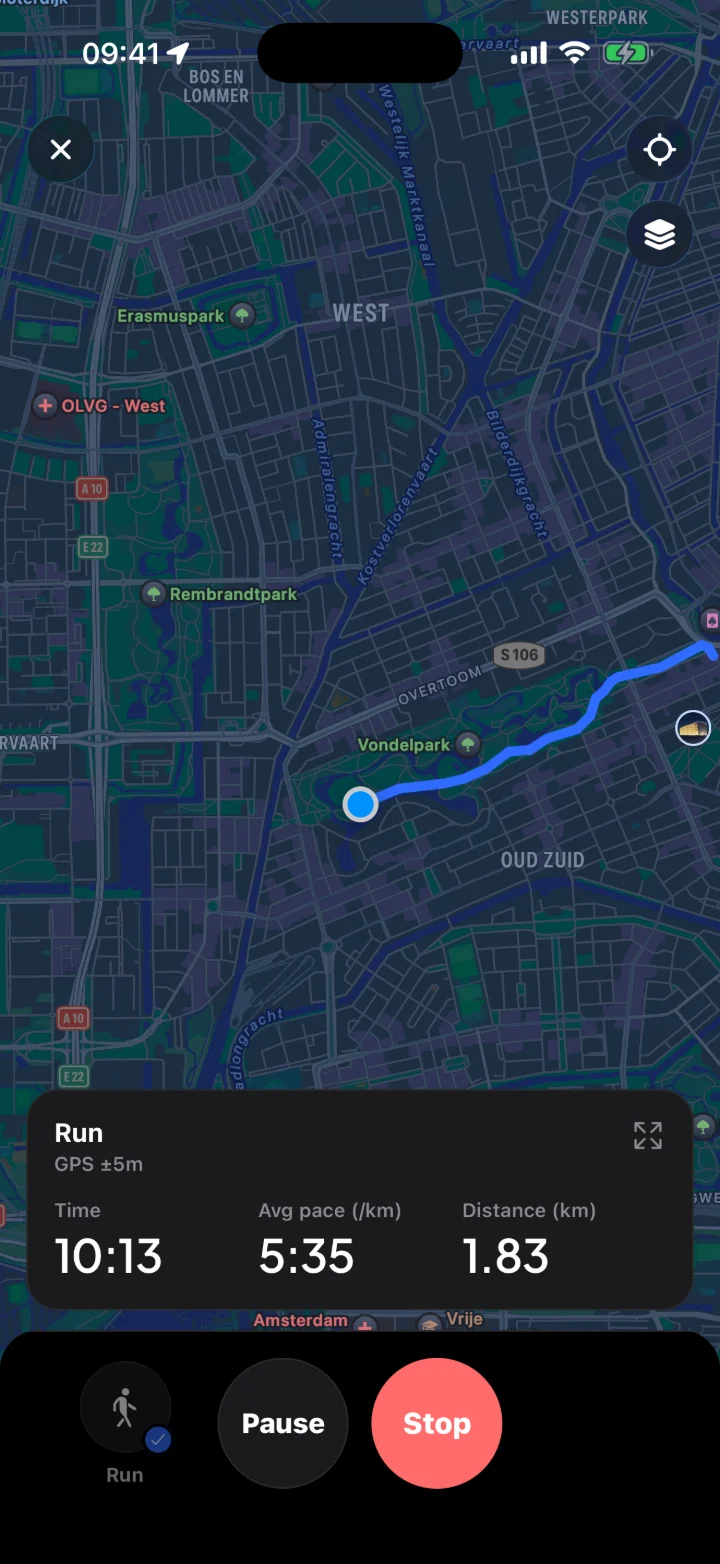
Run with Fuse and see your pace live
Free for iPhone. Android coming soon.

Pace and finish times in one table
Want to know what pace you need for a goal, such as a sub-hour 10K? Enter your distance and target time in the calculator, or find your target time in the table and read off your pace. It works the other way too: choose "Time" at the top and enter your pace.
| Pace (min/km) | 5 km | 10 km | Marathon |
|---|---|---|---|
| 4:00 | 20:00 | 40:00 | 2:48:47 |
| 4:30 | 22:30 | 45:00 | 3:09:53 |
| 5:00 | 25:00 | 50:00 | 3:30:59 |
| 5:30 | 27:30 | 55:00 | 3:52:04 |
| 6:00 | 30:00 | 1:00:00 | 4:13:10 |
| 6:30 | 32:30 | 1:05:00 | 4:34:16 |
| 7:00 | 35:00 | 1:10:00 | 4:55:22 |
| 7:30 | 37:30 | 1:15:00 | 5:16:28 |
| 8:00 | 40:00 | 1:20:00 | 5:37:34 |
How to work out your pace
pace (min/km) = time (minutes) / distance (km)
speed (km/h) = 60 / pace (min/km)
Example: 10 km in 55 minutes is 55 / 10 = 5.5 minutes per kilometer, so 5:30 min/km. That is 60 / 5.5 = 10.9 km/h. Note: 5.5 minutes is 5 minutes and 30 seconds, not 5 minutes and 50 seconds.
Predicting your finish time
The predictions come from Peter Riegel's formula (1981). It says that a race twice as long takes you a little more than twice as long, because your pace slowly drops:
new time = time × (new distance / distance) ^ 1.06
The prediction is most accurate between distances that are not too far apart and if you have also trained for the longer distance. Up to the half marathon it works well in research. For the marathon it is too optimistic for recreational runners: in a study of more than 2,300 runners it predicted a time at least 10 minutes too fast for half of them.
Frequently asked questions
What is a good running pace?
What pace do I need for a sub-25-minute 5K?
How do I convert km/h to min/km?
Predicted finish times are estimates. Build up your distance gradually and listen to your body.
Sources
Run with Fuse and see your pace live.
Running, walking and cycling with GPS. Every minute counts toward your week.
- Your route live on the map
- Distance, time, pace and elevation
- Keeps tracking with your screen off
- Draw your route in advance
Free for iPhone. Android coming soon.
Scan with your iPhone

Keep calculating
- Heart rate zone calculatorYour maximum heart rate and your five zones.
- Calories burned calculatorHow many calories you burn per activity.
- Calorie calculatorHow many calories you need per day (TDEE and BMR).
- BMI calculatorYour BMI and a healthy weight for your height.
- Protein calculatorHow many grams of protein per day, per goal.
- Macro calculatorProtein, carbs and fat in grams per day.