Calorie calculator
How many calories do you need per day? Enter your details and instantly see your resting burn (BMR), your total daily burn (TDEE) and how much to eat to lose weight, maintain or gain.
Exercise 3 to 5 times a week.
To maintain your weight (TDEE)
2,760kcal/day
- Fat loss (−500)
- 2,260 kcal
- Slow fat loss (−250)
- 2,510 kcal
- Muscle gain (+300)
- 3,060 kcal
- Resting burn (BMR)
- 1,780 kcal

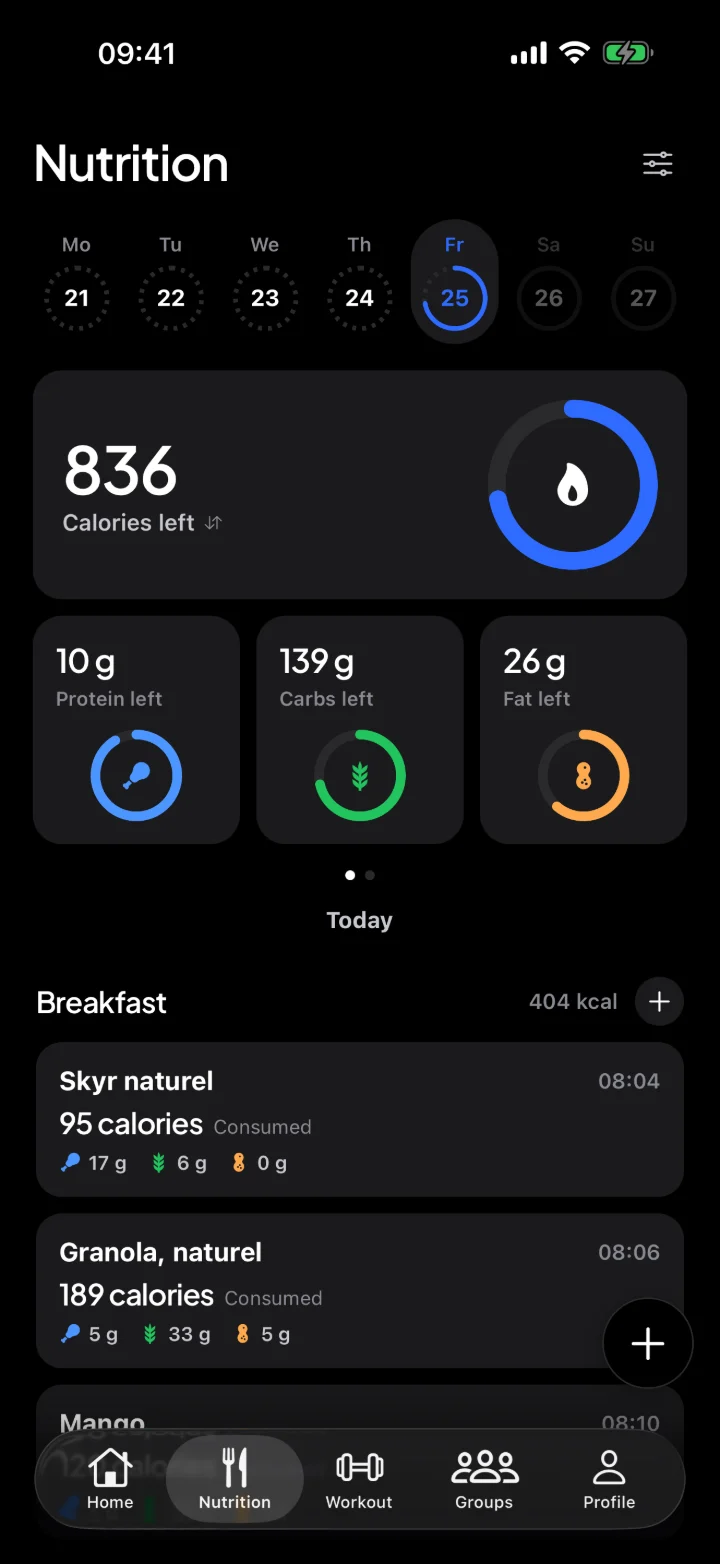
Track your calories in Fuse with a photo or barcode
Free for iPhone. Android coming soon.

BMR and TDEE: what is the difference?
Your BMR (basal metabolic rate) is what your body burns if you lie still all day: for your heart, your breathing, your brain and your temperature. For most people that is already more than half of everything they burn in a day.
Your TDEE (total daily energy expenditure) is your total burn per day: your BMR plus everything you move, from taking the stairs to your workout, and the energy it takes to digest your food. Eat exactly your TDEE and your weight stays the same. Eat less and you lose weight; eat more and you gain.
How this calculator works
We calculate your BMR with the Mifflin-St Jeor equation from 1990. In comparison studies it estimated the resting burn of most adults best among the common equations.
Male: BMR = 10 × weight (kg) + 6.25 × height (cm) − 5 × age + 5
Female: BMR = 10 × weight (kg) + 6.25 × height (cm) − 5 × age − 161
We multiply that BMR by an activity factor. These are the factors almost every TDEE calculator uses; they come from a textbook on exercise and nutrition, not from a single study. Example: a 30-year-old man of 180 cm and 80 kg has a BMR of 10 × 80 + 6.25 × 180 − 5 × 30 + 5 = 1,780 kcal. If he trains 3 to 5 times a week (factor 1.55), his TDEE is about 2,760 kcal per day.
| How active | Factor |
|---|---|
| Sedentary: desk job, no exercise | 1.2 |
| Lightly active: exercise 1 to 3 times a week | 1.375 |
| Moderately active: exercise 3 to 5 times a week | 1.55 |
| Very active: exercise 6 to 7 times a week | 1.725 |
| Extremely active: physical job and daily training | 1.9 |
So do not add your workouts on top of your TDEE: they are already in the factor. If you are torn between two levels, pick the lower one; most people rate themselves as more active than they are.
How many calories to lose or gain weight?
To lose weight you eat less than your TDEE. The Dutch Nutrition Centre (Voedingscentrum) calls about half a kilo per week a good pace, and advises against eating less than 1,500 kcal per day (women) or 1,800 kcal (men). A deficit of 250 to 500 kcal per day is a common example to start with: you lose weight gradually and keep enough energy to train. A bigger deficit is faster, but harder to stick to and more likely to cost muscle.
If you want to build muscle, eat slightly more than your TDEE, such as 300 kcal, and make sure you get enough protein. Eating more does not build muscle faster, it just makes you heavier faster.
Your result is a starting point
Every equation calculates for an average person. Your real burn can be a few hundred kcal higher or lower. So use the result as a start: eat to your goal for two to three weeks, weigh yourself a few times a week at the same time of day and look at the average. If it goes faster or slower than you want, adjust your goal by 100 to 200 kcal.
Frequently asked questions
How many calories do I need per day?
Is the Mifflin-St Jeor equation reliable?
Should I add the calories from my workouts?
Does this apply if I am under 18?
This calculator gives an estimate for healthy adults and is not medical advice. If you are pregnant, breastfeeding or have a medical condition, ask your doctor or a dietitian.
Sources
- Mifflin, M.D. et al. (1990). A new predictive equation for resting energy expenditure in healthy individuals. Am J Clin Nutr 51(2), 241-247.
- Frankenfield, D. et al. (2005). Comparison of predictive equations for resting metabolic rate in healthy nonobese and obese adults: a systematic review. J Am Diet Assoc 105(5), 775-789.
- Voedingscentrum (Netherlands Nutrition Centre): losing weight with healthy food (in Dutch).
- Voedingscentrum: I eat very little and do not lose weight, how come? (in Dutch)
Track your calories in Fuse.
A photo, a barcode or a quick search. Your calorie goal adjusts every week.
- Snap a photo, the AI recognizes your meal
- Scan the barcode on a package
- Your calorie goal adjusts every week
Free for iPhone. Android coming soon.
Scan with your iPhone

Keep calculating
- Macro calculatorProtein, carbs and fat in grams per day.
- Protein calculatorHow many grams of protein per day, per goal.
- Calories burned calculatorHow many calories you burn per activity.
- BMI calculatorYour BMI and a healthy weight for your height.
- Body fat calculatorWith a tape measure, no smart scale needed.
- 1RM calculatorYour one rep max from any set.