Macro calculator
How many grams of protein, carbs and fat do you need per day? Enter your calories, your weight and your goal, and this calculator splits them across the three macros.
Your macros per day
- Protein128g512 kcal, 20%
- Carbs341g1,363 kcal, 55%
- Fat69g625 kcal, 25%
Protein: 1.6 g per kg of body weight.

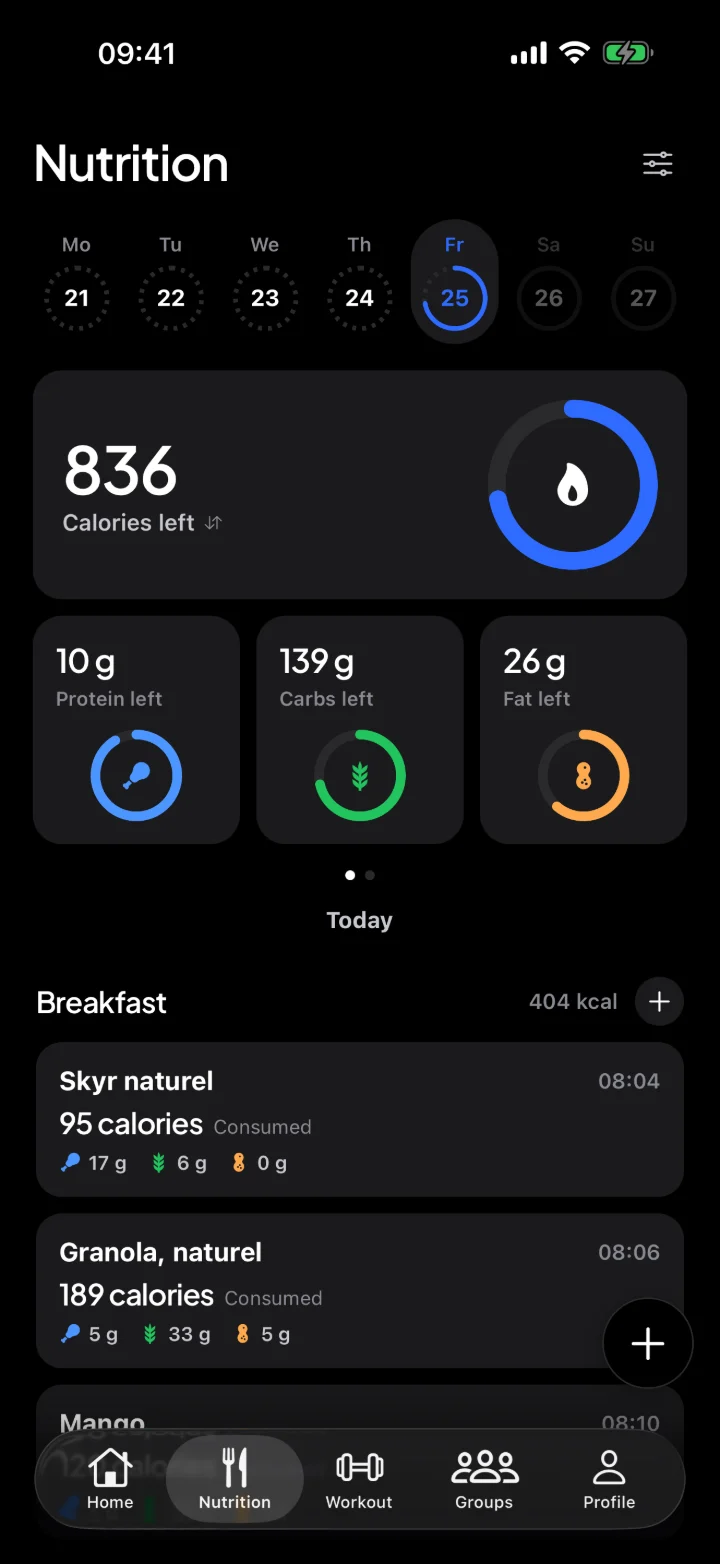
Your macros add up automatically in Fuse
Free for iPhone. Android coming soon.

What are macros?
Macros (macronutrients) are the three nutrients your calories come from: protein, carbs and fat. Two days with the same calories can work out very differently if the split is different. Enough protein helps you keep and build muscle, carbs fuel hard training and you need fat for things like your hormones.
1 g protein = 4 kcal · 1 g carbs = 4 kcal · 1 g fat = 9 kcal
How this calculator splits your calories
Protein first, because it matters most for your muscles. The amount depends on your weight and your goal. If your BMI is 30 or higher, we use an adjusted weight: the weight at a BMI of 25 plus a third of what you weigh above that, as the European Society for Clinical Nutrition (ESPEN) does, since body fat needs hardly any protein. Then fat, as a share of your calories. What is left goes to carbs.
| Goal | Protein per kg | Why |
|---|---|---|
| Fat loss | 2.0 g | When you eat less than you burn, more protein protects your muscle |
| Maintain | 1.6 g | Enough to recover from training |
| Muscle gain | 1.8 g | Above the point where extra protein adds little |
Example: 2,500 kcal, 80 kg, maintain, 25% fat. Protein: 80 × 1.6 = 128 g (512 kcal). Fat: 25% of 2,500 = 625 kcal, divided by 9 = 69 g. Carbs: 2,500 − 512 − 625 = 1,363 kcal, divided by 4 = 341 g.
Macros for fat loss and for muscle gain
When losing weight, the split mainly decides what you lose: with enough protein and strength training you lose mostly fat and less muscle. Protein is also filling, which makes a deficit easier to stick to.
For muscle gain you need enough carbs besides protein to train hard. The rest of the split is mostly about what you enjoy and can keep up: less fat and more carbs or the other way round makes little difference to your results, as long as your calories and protein are right.
Frequently asked questions
Do I have to hit my macros exactly every day?
What is a good split for a woman?
How do I track my macros?
Can I use this calculator for keto?
This calculator is for healthy adults and is not medical advice. If you have a kidney condition or another medical diet, follow the advice of your doctor or dietitian.
Sources
- Jäger, R. et al. (2017). International Society of Sports Nutrition position stand: protein and exercise. JISSN 14, 20.
- Morton, R.W. et al. (2018). A systematic review, meta-analysis and meta-regression of the effect of protein supplementation on resistance training-induced gains in muscle mass and strength. Br J Sports Med 52, 376-384.
- Helms, E.R. et al. (2014). Evidence-based recommendations for natural bodybuilding contest preparation: nutrition and supplementation. JISSN 11, 20.
- Thibault, R. et al. (2021). ESPEN guideline on hospital nutrition. Clin Nutr 40(12), 5684-5709.
Your macros add up automatically in Fuse.
A photo, a barcode or a quick search.
- Snap a photo, the AI recognizes your meal
- Scan the barcode on a package
- Over 1,700 Dutch foods, even offline
Free for iPhone. Android coming soon.
Scan with your iPhone

Keep calculating
- Calorie calculatorHow many calories you need per day (TDEE and BMR).
- Protein calculatorHow many grams of protein per day, per goal.
- Calories burned calculatorHow many calories you burn per activity.
- BMI calculatorYour BMI and a healthy weight for your height.
- Body fat calculatorWith a tape measure, no smart scale needed.
- 1RM calculatorYour one rep max from any set.