Protein calculator
How much protein do you need per day? That mostly depends on your weight and what you do. Enter them and see how many grams of protein you need per day and per meal.
Protein per day
120–165grams
- Per meal (4 meals)
- 36 g
- Per meal (3 meals)
- 48 g
- Cooked chicken breast if it all came from that
- 427 g

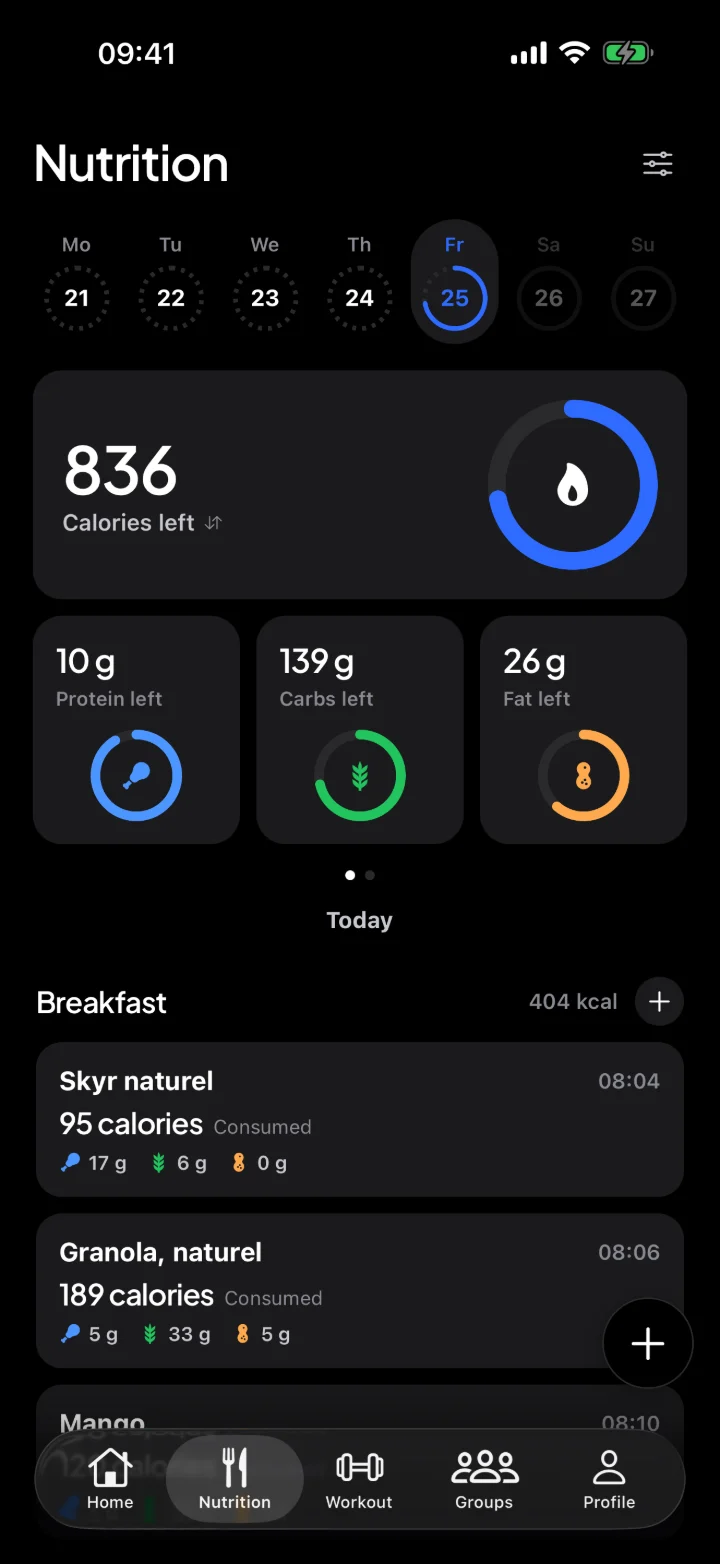
Track your protein in Fuse with a photo or barcode
Free for iPhone. Android coming soon.

How much protein per day?
For a healthy adult who does little exercise, 0.83 grams of protein per kilo of body weight per day is enough. That is the reference intake of the European Food Safety Authority (EFSA), and it is already well above what most people need at minimum. People who exercise, and certainly people who want to build muscle, need more. For athletes, the American and Canadian sports nutrition bodies give 1.2 to 2.0 grams per kilo.
| Who | Grams per kg per day | For 75 kg |
|---|---|---|
| Healthy eating, little exercise | 0.83 | 62 g |
| Regular exercise (cardio, endurance) | 1.2 – 1.6 | 90 – 120 g |
| Strength training, building muscle | 1.6 – 2.2 | 120 – 165 g |
| Losing fat while strength training | 1.8 – 2.5 | 135 – 188 g |
Protein for muscle gain
A large analysis of 49 studies (Morton and colleagues, 2018) found that extra protein helps strength training up to about 1.6 grams per kilo per day. Above that it adds little on average, although some people still benefit up to about 2.2 grams. That is why we use 1.6 to 2.2 grams for muscle gain.
Spread it over the day: three to four meals with a good portion of protein each work better than everything at once. A common guideline is about 0.4 grams per kilo per meal.
Protein when losing fat
When you eat less than you burn, your body also wants to break down muscle. More protein and strength training slow that down. Research in trained people eating less than they burn recommends 2.3 to 3.1 grams per kilo of fat-free mass (your weight without fat). For most people that works out to about 1.8 to 2.5 grams per kilo of body weight. Protein is also filling, which makes a deficit easier.
Protein if you carry a lot of extra weight
Protein per kilo of body weight assumes your weight is mostly muscle, bone and organs. With a lot of extra weight that no longer holds: body fat needs hardly any protein, so the number comes out too high. That is why this calculator also asks your height. If your BMI is 30 or higher, we use an adjusted weight: the weight at a BMI of 25 plus a third of what you weigh above that. The European Society for Clinical Nutrition (ESPEN) calculates it the same way.
Example: 120 kg at 1.80 m is a BMI of 37. The weight at BMI 25 is 81 kg, and a third of the 39 kg above that is 13 kg. So the adjusted weight is 94 kg. Losing fat while strength training then gives 169 to 235 grams of protein per day, instead of 216 to 300.
How much protein is in your food?
A few everyday foods, with the values from the Fuse food list. Brands differ; check the label if in doubt.
| Food | Serving | Protein |
|---|---|---|
| Chicken breast, cooked | 1 fillet (120 g) | 40 g |
| Lean ground beef, cooked | 1 serving (125 g) | 33 g |
| Tuna in water, canned | 1 can (80 g) | 19 g |
| Plain skyr | 1 pot (150 g) | 17 g |
| Low-fat quark | 1 pot (150 g) | 15 g |
| Greek yogurt 0% | 1 bowl (150 g) | 15 g |
| Plain tofu | 1 serving (100 g) | 17 g |
| Lentils, cooked | 1 serving (150 g) | 14 g |
| Egg, boiled | 1 egg (55 g) | 7 g |
| Semi-skimmed milk | 1 glass (200 ml) | 7 g |
| Gouda cheese | 1 slice (20 g) | 5 g |
| Rolled oats | 1 serving (40 g) | 5 g |
| Peanut butter | 1 tablespoon (15 g) | 4 g |
Frequently asked questions
How much protein does a man need per day?
How much protein does a woman need per day?
Is too much protein bad?
Do older adults need more protein?
Do I need protein shakes?
This calculator is for healthy adults and is not medical advice. If you are pregnant, over 70 or have a kidney condition, ask your doctor or a dietitian what applies to you.
Sources
- EFSA (2012). Dietary reference values for protein (press release).
- Health Council of the Netherlands (2021). Dietary reference values for proteins: no higher protein requirement for older adults (in Dutch).
- Voedingscentrum (Netherlands Nutrition Centre): protein (in Dutch).
- Morton, R.W. et al. (2018). A systematic review, meta-analysis and meta-regression of the effect of protein supplementation on resistance training-induced gains in muscle mass and strength. Br J Sports Med 52, 376-384.
- Jäger, R. et al. (2017). International Society of Sports Nutrition position stand: protein and exercise. JISSN 14, 20.
- Helms, E.R. et al. (2014). A systematic review of dietary protein during caloric restriction in resistance trained lean athletes: a case for higher intakes. Int J Sport Nutr Exerc Metab 24(2), 127-138.
- Schoenfeld, B.J. and Aragon, A.A. (2018). How much protein can the body use in a single meal for muscle-building? JISSN 15, 10.
- Thomas, D.T., Erdman, K.A. and Burke, L.M. (2016). Nutrition and athletic performance (ACSM, Academy of Nutrition and Dietetics, Dietitians of Canada). Med Sci Sports Exerc 48(3), 543-568.
- Thibault, R. et al. (2021). ESPEN guideline on hospital nutrition. Clin Nutr 40(12), 5684-5709.
See how much protein you have had in Fuse.
Log your food with a photo, a barcode or a quick search, and your protein adds up automatically.
- Snap a photo, the AI recognizes your meal
- Scan the barcode on a package
- Over 1,700 Dutch foods, even offline
Free for iPhone. Android coming soon.
Scan with your iPhone

Keep calculating
- Macro calculatorProtein, carbs and fat in grams per day.
- Calorie calculatorHow many calories you need per day (TDEE and BMR).
- 1RM calculatorYour one rep max from any set.
- BMI calculatorYour BMI and a healthy weight for your height.
- Body fat calculatorWith a tape measure, no smart scale needed.
- Calories burned calculatorHow many calories you burn per activity.