Calories burned calculator
How many calories do you burn walking, cycling, swimming, running or lifting weights? Pick your activity, enter how long and how much you weigh, and instantly see your burn. Further down you will also find it per mile.
You burn about
349kcal
- Of which from the activity itself
- 311 kcal
- Per hour
- 698 kcal

Log your workouts and runs in Fuse
Free for iPhone. Android coming soon.

How this calculator works
Every activity has a MET value: how many times more energy you use than at rest. Rest is 1 MET, walking around 4, running at 10 km/h around 9. The values come from the Compendium of Physical Activities, a large collection of measurements from research. Because 1 MET is about 1 kcal per kilo of body weight per hour, you calculate:
kcal = MET × weight (kg) × time (hours)
Example: 30 minutes of running at 9.7 km/h (9.3 MET) at 75 kg is 9.3 × 75 × 0.5 = 349 kcal. That includes your resting burn: what you would have burned on the couch in those 30 minutes anyway (1 MET, here 38 kcal). So the activity itself adds about 310 kcal.
The calculation only looks at your weight. For walking and running, that is also what matters most: per kilogram, women and men burn about the same. Your age, build and fitness do make a difference, and not always in the same direction. The Compendium itself calls its values a starting point, not a precise burn for one person. On an exercise bike at a set wattage, your weight matters less: there the calculation gives too much for heavier people and too little for lighter people.
Calories burned per activity
For your weight (75 kg), per half hour and per hour. Enter a different weight at the top and the table updates.
| Activity | 30 min | 60 min |
|---|---|---|
| Strength training, moderate | 131 kcal | 263 kcal |
| Strength training, vigorous (powerlifting, bodybuilding) | 225 kcal | 450 kcal |
| Elliptical, moderate | 188 kcal | 375 kcal |
| Elliptical, vigorous | 338 kcal | 675 kcal |
| Stair machine | 349 kcal | 698 kcal |
| Stair climbing, general | 255 kcal | 510 kcal |
| Circuit training, vigorous | 281 kcal | 563 kcal |
| HIIT, vigorous (burpees, jumps, Tabata) | 413 kcal | 825 kcal |
| Walking, 4.5 to 5.5 km/h (2.8 to 3.4 mph) | 143 kcal | 285 kcal |
| Brisk walking, 5.6 to 6.3 km/h (3.5 to 3.9 mph) | 180 kcal | 360 kcal |
| Very brisk walking, 6.4 to 7.1 km/h (4.0 to 4.4 mph) | 206 kcal | 413 kcal |
| Uphill walking, 1 to 5% grade | 199 kcal | 398 kcal |
| Uphill walking, 6 to 10% grade | 263 kcal | 525 kcal |
| Hiking, cross country | 225 kcal | 450 kcal |
| Hiking with a daypack | 293 kcal | 585 kcal |
| Running, 8 km/h (5 mph) | 319 kcal | 638 kcal |
| Running, 9.7 km/h (6 mph) | 349 kcal | 698 kcal |
| Running, 11.3 km/h (7 mph) | 413 kcal | 825 kcal |
| Running, 12.9 km/h (8 mph) | 450 kcal | 900 kcal |
| Running, 16.1 km/h (10 mph) | 555 kcal | 1,110 kcal |
| Cycling, leisure, about 15 km/h (9.4 mph) | 218 kcal | 435 kcal |
| Cycling, 16 to 19 km/h (10 to 11.9 mph) | 255 kcal | 510 kcal |
| Cycling, 19 to 22 km/h (12 to 13.9 mph) | 300 kcal | 600 kcal |
| Cycling, 22 to 25 km/h (14 to 15.9 mph) | 375 kcal | 750 kcal |
| Road cycling, 26 to 30 km/h (16 to 19 mph), estimated value | 450 kcal | 900 kcal |
| Road cycling, over 32 km/h (20 mph) | 630 kcal | 1,260 kcal |
| E-bike, light pedal assist | 225 kcal | 450 kcal |
| E-bike, high pedal assist | 150 kcal | 300 kcal |
| Exercise bike, general | 255 kcal | 510 kcal |
| Indoor cycling class | 338 kcal | 675 kcal |
| Lap swimming, slow (freestyle) | 218 kcal | 435 kcal |
| Lap swimming, fast (freestyle) | 368 kcal | 735 kcal |
| Swimming, breaststroke, recreational | 199 kcal | 398 kcal |
| Swimming, breaststroke, training or competition | 386 kcal | 773 kcal |
| Rowing machine, moderate (under 100 watts) | 188 kcal | 375 kcal |
| Rowing machine, vigorous (100 to 149 watts) | 281 kcal | 563 kcal |
| Jumping rope, moderate pace | 443 kcal | 885 kcal |
| Soccer, casual | 263 kcal | 525 kcal |
| Yoga (hatha) | 86 kcal | 173 kcal |
Calories burned per mile
If you walk or run a distance, the time depends on your speed: the distance divided by your speed. So per mile you calculate:
kcal per mile = MET × weight (kg) ÷ speed (mph)
Example: walking at about 3.1 mph (3.8 MET) at 75 kg (165 lb) is 3.8 × 75 ÷ 3.1 = 92 kcal per mile. Walk 3 miles and that is about 280 kcal, of which about 200 from the walking itself.
Running costs about 1 kcal per kilogram of body weight per kilometer (about 0.7 kcal per pound per mile), and that barely depends on your pace: run faster and you burn more per minute, but you also finish sooner. At 75 kg the table gives 111 to 128 kcal per mile. Walking costs less per mile: between 2.5 and 4.4 mph, about 0.55 to 0.6 kcal per pound. For your weight (75 kg):
| Activity | Per mile | Per km |
|---|---|---|
| Walking, 4.5 to 5.5 km/h (2.8 to 3.4 mph) | 92 kcal | 57 kcal |
| Brisk walking, 5.6 to 6.3 km/h (3.5 to 3.9 mph) | 97 kcal | 60 kcal |
| Very brisk walking, 6.4 to 7.1 km/h (4.0 to 4.4 mph) | 98 kcal | 61 kcal |
| Running, 5 mph (12:00 min/mile) | 128 kcal | 79 kcal |
| Running, 6 mph (10:00 min/mile) | 116 kcal | 72 kcal |
| Running, 7 mph (8:34 min/mile) | 118 kcal | 73 kcal |
| Running, 8 mph (7:30 min/mile) | 113 kcal | 70 kcal |
| Running, 10 mph (6:00 min/mile) | 111 kcal | 69 kcal |
On a flat treadmill, walking burns about the same as on a flat road. Running does too, up to about 12 km/h (7.5 mph). Run faster and a flat belt is slightly easier than running outdoors.
To work out your pace and finish time, use the running pace calculator.
Calories burned lifting weights
Regular strength training is 3.5 MET, heavy training such as powerlifting or bodybuilding 6.0. For your weight (75 kg) that is:
| Duration | Moderate | Vigorous |
|---|---|---|
| 15 min | 66 kcal | 113 kcal |
| 30 min | 131 kcal | 225 kcal |
| 45 min | 197 kcal | 338 kcal |
| 60 min | 263 kcal | 450 kcal |
Per minute, running burns more than weight training: the Compendium gives weight training 3.5 to 6.0 METs, and running at 8 to 16 km/h (5 to 10 mph) 8.5 to 14.8 METs. You keep burning a little extra after a workout, the so-called afterburn. It is small: in studies of endurance exercise, even after long or hard sessions, it was 6 to 15 percent of what the workout itself cost. For strength training it has been studied less. The World Health Organization recommends both: aerobic exercise and muscle-strengthening activities. You can track your sets and weights in the Fuse workout tracker app.
How many calories do you burn a day?
What you burn in a day is much more than your workout. Your body also uses energy at rest (your BMR), and on top of that comes everything you do during the day. This calculator only gives the part from one activity. To work out what you burn at rest and per day, use the calorie calculator, with your sex, age, height and weight.
Why your watch says something different
A MET value is an average for everyone who does that activity. How fit you are, how efficiently you move and how hard you really train all make a difference. A sports watch estimates your burn from your movement and often your heart rate. It usually gets your heart rate right, but not your calories. In a 2017 study of 60 people and 7 wrist-worn devices, no device was within 20 percent, and the median error per device ranged from 27 to 93 percent. Later reviews of dozens of studies also found no brand that measures calorie burn accurately. So treat every result as a guide, not an exact measurement.
Frequently asked questions
How many calories does strength training burn?
How many calories do 10,000 steps burn?
Should I eat back the calories I burn?
These results are estimates based on research averages for adults aged 19 to 59. They do not apply to pregnant women or to people with a condition that changes how much energy they use. For people over 60 there is a separate compendium with its own values.
Sources
- Herrmann, S.D. et al. (2024). 2024 Adult Compendium of Physical Activities: a third update of the energy costs of human activities. J Sport Health Sci 13(1), 6-12.
- Compendium of Physical Activities (online, with all codes).
- Ainsworth, B.E. et al. (2011). 2011 Compendium of Physical Activities: a second update of codes and MET values. Med Sci Sports Exerc 43(8), 1575-1581.
- Willis, E.A. et al. (2024). Older Adult Compendium of Physical Activities: energy costs of human activities in adults aged 60 and older. J Sport Health Sci 13(1), 13-17.
- Margaria, R. et al. (1963). Energy cost of running. J Appl Physiol 18, 367-370.
- Jones, A.M., Doust, J.H. (1996). A 1% treadmill grade most accurately reflects the energetic cost of outdoor running. J Sports Sci 14(4), 321-327.
- Browning, R.C. et al. (2006). Effects of obesity and sex on the energetic cost and preferred speed of walking. J Appl Physiol 100(2), 390-398.
- Murtagh, E.M. et al. (2021). Outdoor walking speeds of apparently healthy adults: a systematic review and meta-analysis. Sports Med 51(1), 125-141.
- Shcherbina, A. et al. (2017). Accuracy in wrist-worn, sensor-based measurements of heart rate and energy expenditure in a diverse cohort. J Pers Med 7(2), 3.
- O'Driscoll, R. et al. (2020). How well do activity monitors estimate energy expenditure? A systematic review and meta-analysis of the validity of current technologies. Br J Sports Med 54(6), 332-340.
- Germini, F. et al. (2022). Accuracy and acceptability of wrist-wearable activity-tracking devices: systematic review of the literature. J Med Internet Res 24(1), e30791.
- LaForgia, J., Withers, R.T., Gore, C.J. (2006). Effects of exercise intensity and duration on the excess post-exercise oxygen consumption. J Sports Sci 24(12), 1247-1264.
- Bull, F.C. et al. (2020). World Health Organization 2020 guidelines on physical activity and sedentary behaviour. Br J Sports Med 54(24), 1451-1462.
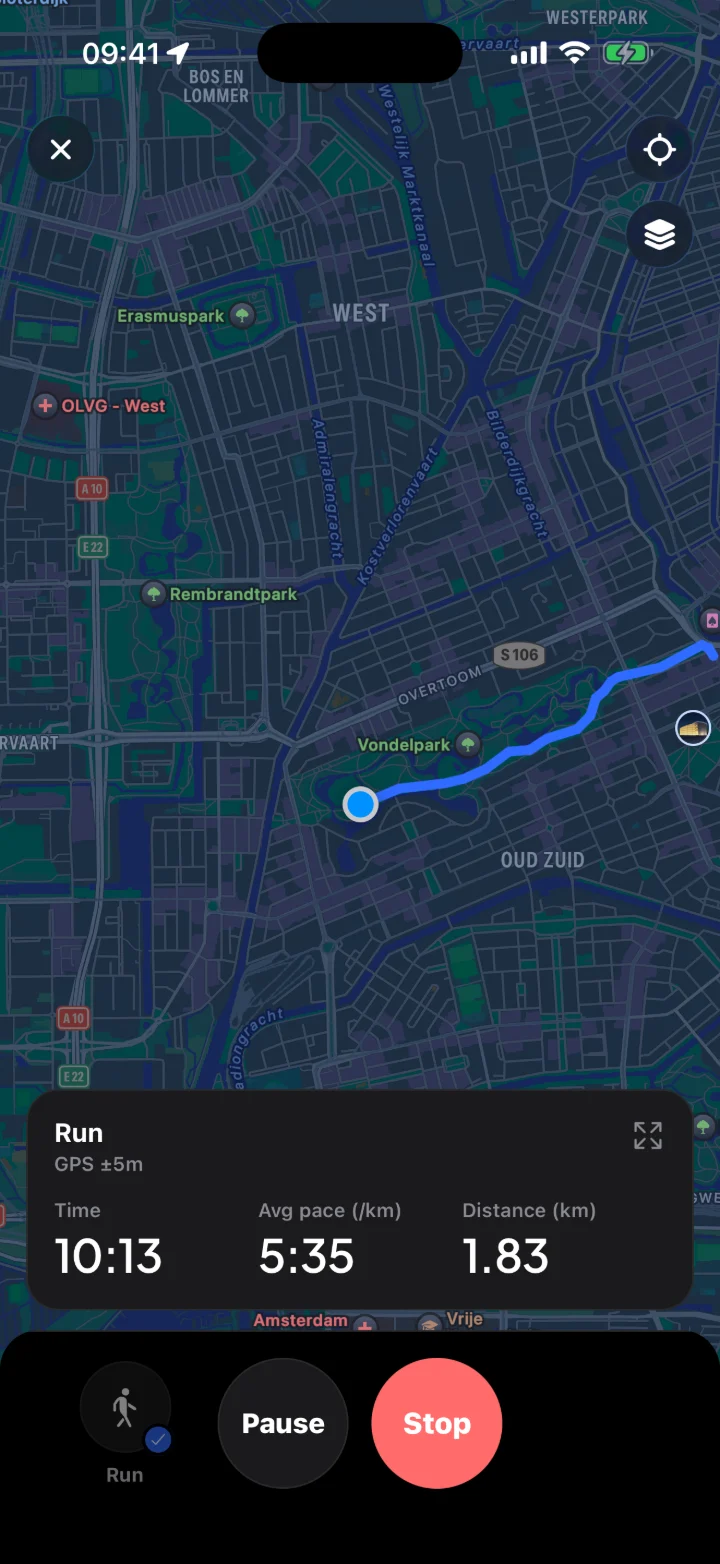
Every minute counts in Fuse.
Track your workouts, your runs and your nutrition in 1 app, and take on your friends every week.
- Running, walking and cycling with GPS
- Distance, time, pace and elevation
- Who trained the longest this week
Free for iPhone. Android coming soon.
Scan with your iPhone

Keep calculating
- Calorie calculatorHow many calories you need per day (TDEE and BMR).
- Running pace calculatorYour pace, finish time or distance, and your speed.
- Heart rate zone calculatorYour maximum heart rate and your five zones.
- Macro calculatorProtein, carbs and fat in grams per day.
- Protein calculatorHow many grams of protein per day, per goal.
- BMI calculatorYour BMI and a healthy weight for your height.