1RM calculator
Your 1RM (one rep max) is the heaviest weight you can lift exactly once. Enter a set you did recently and this calculator estimates your 1RM and your training weights, without a heavy max attempt.
Most reliable up to 10 reps.
Your estimated 1RM
100.3kg
- 90% of your 1RM
- 90 kg
- 80% of your 1RM
- 80 kg
- 70% of your 1RM
- 70 kg

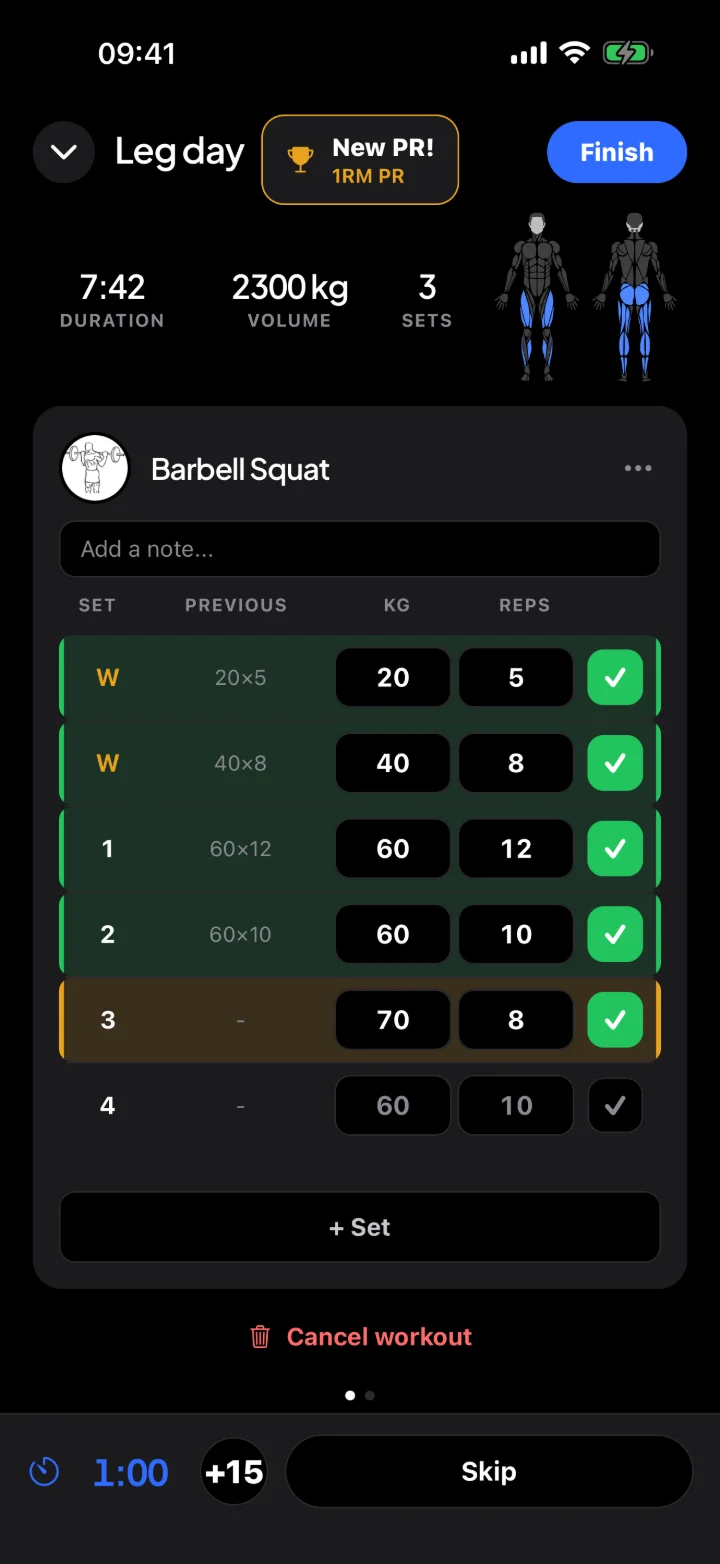
Log your sets in Fuse, new records in gold
Free for iPhone. Android coming soon.

Your training weights at every percentage
Training programs often prescribe a percentage of your 1RM, such as 5 x 5 at 80%. This table works that out for your 1RM, rounded to what you can load on the bar. The reps come from the table in the NSCA textbook (Haff and Triplett, 2016). In studies, many people manage more reps than the table says at the lighter weights.
| Percentage | Weight | About reps |
|---|---|---|
| 100% | 100 kg | 1 |
| 95% | 95 kg | 2 |
| 93% | 92.5 kg | 3 |
| 90% | 90 kg | 4 |
| 87% | 87.5 kg | 5 |
| 85% | 85 kg | 6 |
| 83% | 82.5 kg | 7 |
| 80% | 80 kg | 8 |
| 77% | 77.5 kg | 9 |
| 75% | 75 kg | 10 |
| 70% | 70 kg | 11 |
| 67% | 67.5 kg | 12 |
| 65% | 65 kg | 15 |
| 60% | 60 kg | warm-up, technique |
| 50% | 50 kg | warm-up, technique |
How the 1RM calculator works
No formula knows your 1RM exactly. But some formulas make a good estimate from a heavy set of several reps. The two best known are Epley and Brzycki:
Epley: 1RM = weight × (1 + reps / 30)
Brzycki: 1RM = weight × 36 / (37 − reps)
Example: 80 kg for 8 reps. Epley gives 80 × (1 + 8/30) = 101.3 kg, Brzycki gives 80 × 36 / 29 = 99.3 kg. This calculator takes the average: 100.3 kg. Up to about 10 reps the two formulas stay close; above that they drift apart and every estimate gets less certain.
Why estimating beats testing
A real 1RM test is hard on your muscles and joints, needs a proper warm-up and a spotter, and costs you a few days of recovery. For most people that is not worth it: an estimate from a set of 3 to 8 reps is usually close enough to base your training on.
Tip: use a set that was hard but with good technique, and calculate each exercise separately. Your bench press 1RM says nothing about your squat or deadlift.
Frequently asked questions
What does 1RM mean?
How accurate is a 1RM calculation?
Does this work for bench press, squat and deadlift?
How often should I recalculate my 1RM?
This calculator gives an estimate, not a guarantee. Only attempt a max with a proper warm-up and a spotter or safety bars.
Sources
- Brzycki, M. (1993). Strength testing: predicting a one-rep max from reps-to-fatigue. JOPERD 64(1), 88-90.
- LeSuer, D.A. et al. (1997). The accuracy of prediction equations for estimating 1-RM performance in the bench press, squat, and deadlift. J Strength Cond Res 11(4), 211-213.
- Nuzzo, J.L. et al. (2024). Maximal number of repetitions at percentages of the one repetition maximum: a meta-regression and moderator analysis. Sports Med 54(2), 303-321.
- Sheppard, J.M. and Triplett, N.T. (2016). Program design for resistance training. In: Haff, G.G. and Triplett, N.T. (eds.), Essentials of Strength Training and Conditioning, 4th edition. Human Kinetics, p. 452. The table of percentages and reps.
Track your weights in Fuse.
Log your sets in a few taps. Fuse remembers what you lifted last time and shows you when you get stronger.
- Your last weights, already filled in
- New records in gold
- Rest timer with a notification
Free for iPhone. Android coming soon.
Scan with your iPhone

More calculators
- Calorie calculatorHow many calories you need per day (TDEE and BMR).
- Macro calculatorProtein, carbs and fat in grams per day.
- Protein calculatorHow many grams of protein per day, per goal.
- BMI calculatorYour BMI and a healthy weight for your height.
- Body fat calculatorWith a tape measure, no smart scale needed.
- Running pace calculatorYour pace, finish time or distance, and your speed.