Macro calculator
How many calories and how many grams of protein, carbs and fat do you need per day for muscle gain, maintenance or fat loss? Enter your details and your goal: this calculator works out your calories and splits them across the three macros, for men and women. Already know your calories? Then enter them yourself.
Exercise 3 to 5 times a week.
Your macros per day
2,760 kcal per day: your daily burn, to maintain your weight
- Protein128g512 kcal, 19%
- Carbs390g1,558 kcal, 56%
- Fat77g690 kcal, 25%
Protein: 1.6 g per kg of body weight.

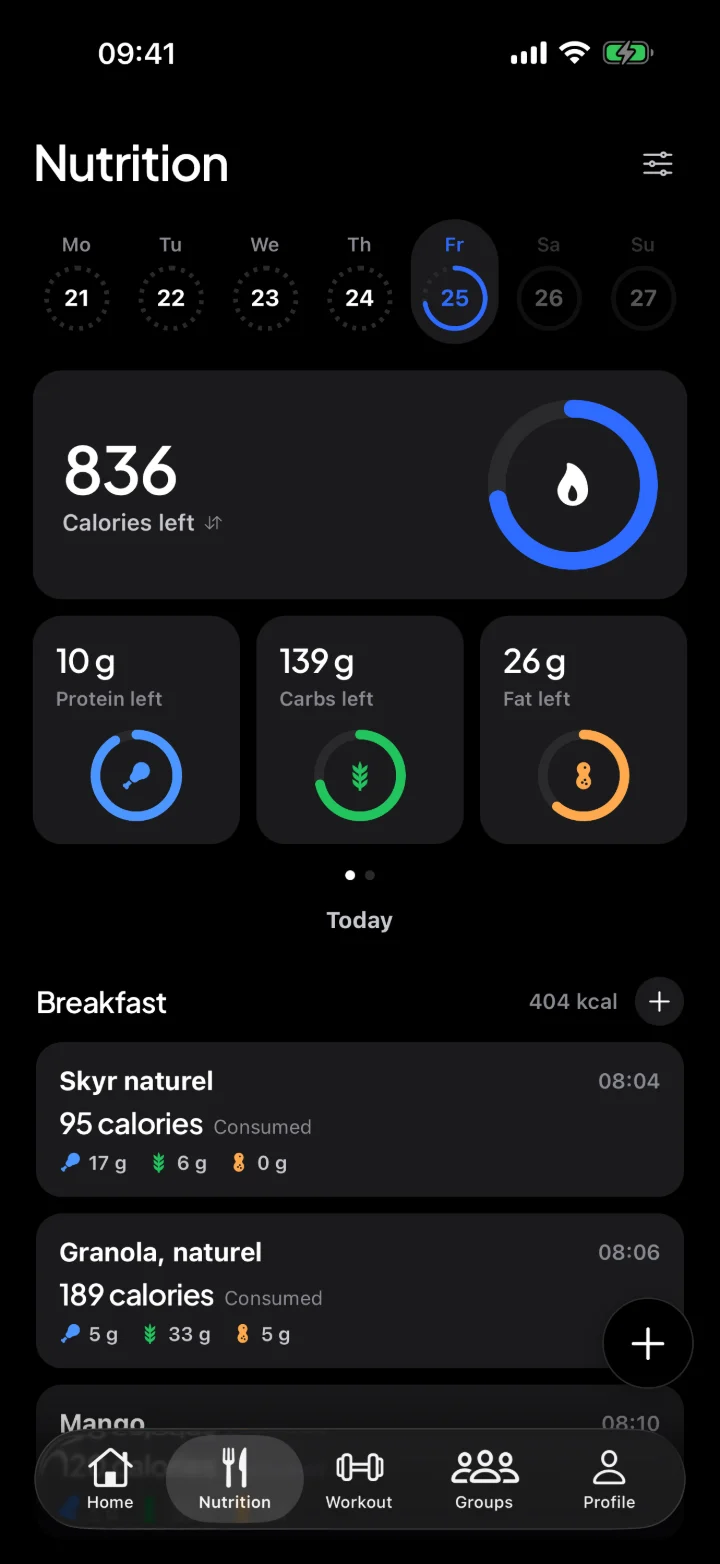
Your macros add up automatically in Fuse
Free for iPhone. Android coming soon.

What are macros?
Macros (macronutrients) are the three nutrients your calories come from: protein, carbs and fat. Two days with the same calories can work out very differently if the split is different. Enough protein helps you keep and build muscle, carbs fuel hard training and you need fat for things like your hormones.
1 g protein = 4 kcal · 1 g carbs = 4 kcal · 1 g fat = 9 kcal
How this calculator splits your calories
Calories first. If you choose "Calculate my calories", the calculator works out your daily burn the same way as the calorie calculator: your resting burn with the Mifflin-St Jeor equation, times a factor for how active you are. Then it adjusts that to your goal: less to lose fat, exactly your burn to maintain and a little more for muscle gain. How much is explained below. For fat loss it never goes below 1,500 kcal per day for women and 1,800 for men, a limit the Dutch Nutrition Centre gave in earlier advice. If you already know your calories, enter them yourself; the goal then only changes your protein.
Then the split. Protein first, because it matters most for your muscles. The amount depends on your weight and your goal. If your BMI is 30 or higher, we use an adjusted weight: the weight at a BMI of 25 plus a third of what you weigh above that, as the European Society for Clinical Nutrition (ESPEN) does, since body fat needs hardly any protein. Then fat, as a share of your calories. What is left goes to carbs.
| Goal | Protein per kg | Why |
|---|---|---|
| Fat loss and slow fat loss | 2.0 g | When you eat less than you burn, more protein protects your muscle |
| Maintain | 1.6 g | Enough to recover from training |
| Muscle gain | 1.8 g | Above the point where extra protein adds little |
Example: a 30-year-old man of 180 cm and 80 kg who exercises 3 to 5 times a week burns about 2,760 kcal per day. For muscle gain that becomes 2,760 plus 10% = 3,040 kcal (rounded to the nearest 10). Protein: 80 × 1.8 = 144 g (576 kcal). Fat: 25% of 3,040 = 760 kcal, divided by 9 = 84 g. Carbs: 3,040 − 576 − 760 = 1,704 kcal, divided by 4 = 426 g.
Macros for muscle gain (lean bulk)
For muscle gain we add 10 percent to your burn. A small surplus is enough: eating more often adds mostly fat, not muscle. Aim for a quarter to half a percent of your weight per week. At 80 kg that is 0.2 to 0.4 kg per week. If you have trained for a few years, aim for the low end.
Iraki et al. (2019) suggest about 10 to 20 percent above your daily burn for beginners and intermediate lifters, and 5 to 10 percent for advanced lifters. Protein: 1.6 to 2.2 g per kg of body weight per day; this calculator uses 1.8 g. Fat: 20 to 35 percent of your calories, a share you choose yourself. What is left goes to carbs.
For muscle gain you need enough carbs besides protein to train hard. The rest of the split is mostly about what you enjoy and can keep up: less fat and more carbs or the other way round makes little difference to your results, as long as your calories and protein are right.
Macros for fat loss
For fat loss you eat 500 kcal less than you burn, for slow fat loss 250 kcal. At first that is about half a kilo and a quarter of a kilo per week. The Dutch Nutrition Centre advises not to lose more than about half a kilo per week. If you are already lean, choose slow fat loss: it helps you keep your muscle.
When losing weight, the split mainly decides what you lose: with enough protein and strength training you lose mostly fat and less muscle. Protein is also filling, which makes a deficit easier to stick to.
Lose fat and build muscle at the same time
It is possible, even if you already train (Barakat et al., 2020). It is also called body recomposition. It works best if you are new to strength training, coming back after a break or carrying more fat. Lift weights at least three times a week and keep making it a bit harder, eat enough protein and keep the deficit small: choose slow fat loss. If you have trained for years and are lean, it goes much more slowly.
Macros for women
For women the calculator works the same way. The guidelines for protein per kilo are the same as for men. Your burn is usually lower, and the equation already accounts for that. Example: a 30-year-old woman of 165 cm and 60 kg who exercises 3 to 5 times a week burns about 2,050 kcal per day. To lose fat slowly, that becomes 1,800 kcal, with 120 g protein, 50 g fat and 218 g carbs (at 25% fat).
Do not eat too little for a long time if you train a lot. If your period stops, you feel tired all the time, often get ill or injured, or stop getting stronger, you may not be eating enough. See your doctor.
Your result is a starting point
Every equation calculates for an average person; your real burn can be a few hundred kcal off. So weigh yourself at a fixed time, for example in the morning after the bathroom: once a week on the same day, or more often and take the weekly average. After two to three weeks (three to four for muscle gain), check whether you are on pace. If not, adjust your calories by 100 to 200 kcal.
Frequently asked questions
Do I have to hit my macros exactly every day?
How do I track my macros?
Can I use this calculator for keto?
Does this apply if I am under 18?
This calculator is for healthy adults and is not medical advice. If you have a kidney condition or another medical diet, follow the advice of your doctor or dietitian.
Sources
- Jäger, R. et al. (2017). International Society of Sports Nutrition position stand: protein and exercise. JISSN 14, 20.
- Morton, R.W. et al. (2018). A systematic review, meta-analysis and meta-regression of the effect of protein supplementation on resistance training-induced gains in muscle mass and strength. Br J Sports Med 52, 376-384.
- Helms, E.R. et al. (2014). Evidence-based recommendations for natural bodybuilding contest preparation: nutrition and supplementation. JISSN 11, 20.
- Iraki, J. et al. (2019). Nutrition recommendations for bodybuilders in the off-season: a narrative review. Sports 7(7), 154.
- Barakat, C. et al. (2020). Body recomposition: can trained individuals build muscle and lose fat at the same time? Strength Cond J 42(5), 7-21.
- Sims, S.T. et al. (2023). International Society of Sports Nutrition position stand: nutritional concerns of the female athlete. JISSN 20(1), 2204066.
- Mifflin, M.D. et al. (1990). A new predictive equation for resting energy expenditure in healthy individuals. Am J Clin Nutr 51(2), 241-247.
- Voedingscentrum (Netherlands Nutrition Centre): losing weight with healthy food (in Dutch).
- Voedingscentrum: I eat very little and do not lose weight, how come? (in Dutch). Archived copy from February 17, 2026; the page is no longer online.
- Thibault, R. et al. (2021). ESPEN guideline on hospital nutrition. Clin Nutr 40(12), 5684-5709.
Your macros add up automatically in Fuse.
A photo, a barcode or a quick search.
- Snap a photo, the AI recognizes your meal
- Scan the barcode on a package
- Over 1,700 Dutch foods, even offline
Free for iPhone. Android coming soon.
Scan with your iPhone

Keep calculating
- Calorie calculatorHow many calories you need per day (TDEE and BMR).
- Protein calculatorHow many grams of protein per day, per goal.
- Calories burned calculatorHow many calories you burn per activity.
- BMI calculatorYour BMI and a healthy weight for your height.
- Body fat calculatorWith a tape measure, no smart scale needed.
- 1RM calculatorYour one rep max from a heavy set.